
Industrial relocations. Playing chess while others play strongman.
B2B Strategy | Content Marketing | LinkedIn | Case Study & Video | Employer Branding

The market heard about tonnage. We wanted it to hear about the process
.
In a world where every heavy-lifting company shows the same picture — a massive crane hoisting a massive load — Protech Motors faced a different challenge:
How do you show that the real value isn’t in lifting power, but in intellectual power? How do you prove that they’re not selling transport — that clients are buying production continuity?
Client:
Protech Motors
Completion date:
2025–2026
Scope of work:
B2B Strategy | Content Marketing | LinkedIn | Case Study & Video | Employer Branding

The brand needed communication that:

Speaks the language of an engineer, not a salesperson. The language of process, plan, and metrics.

Builds authority, not just showcases a portfolio. Educates the market instead of just serving it.

Hits the decision-maker's real fear, (Project Manager, Plant Director): uncontrolled downtime, failure, and reputational loss.
And this is where we defined our mission
The challenge – how to break free from the “how much per ton?” trap
.


Brand in the wrong drawer
The market perceived relocations as a transport service. Price, not risk-management competence, became the key criterion. The brand needed to be pulled out of the “carrier” category.

Invisible expertise
Protech’s greatest value — planning, risk engineering, audits, scenarios — happens “behind the scenes.” Competitors’ social media only showed the “wow” effect, ignoring the process

Communication without a benefit-driven language
Technical descriptions and dry data didn’t land with business decision-makers. What was missing was translating equipment capabilities into concrete benefits: shorter operation time, safety, no downtime.

Content that doesn't build trust
There was a lack of repeatable, educational formats that would position Protech as an expert partner and the go-to source of industry knowledge, especially on the key B2B channel — LinkedIn.
The architecture of change: four pillars that built a new image

We created an “Operation” format, not a “Project”
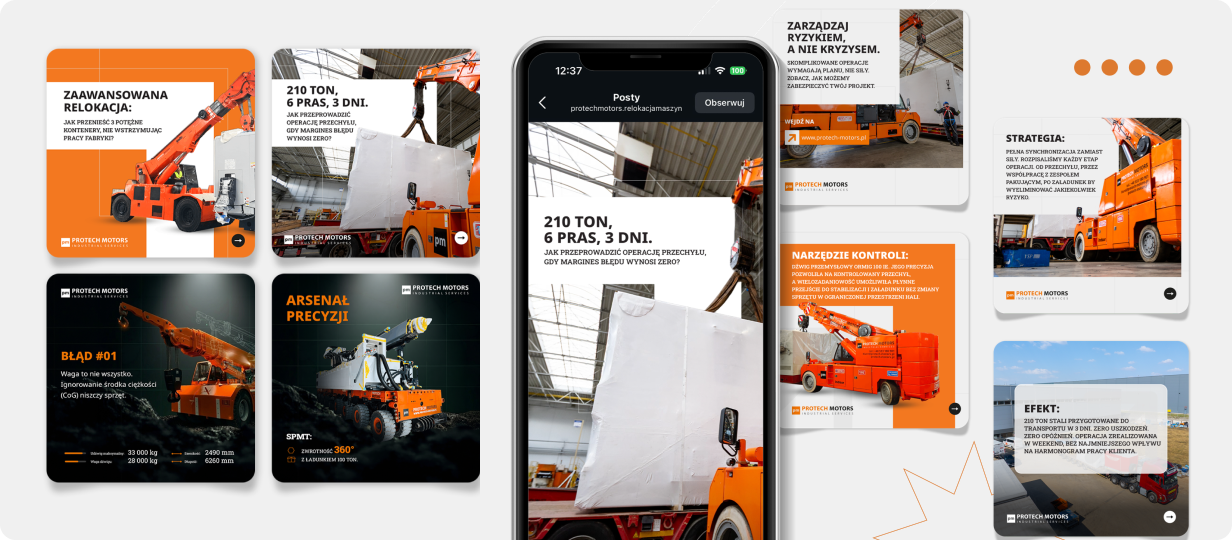
We turned every Case Study into an engaging story told as a LinkedIn carousel. Instead of bragging about lifting capacity, we walk the decision-maker through the process: business stake -> risks -> plan -> tool selection -> result. It’s proof of competence, not brute strength.

We started educating — “Risk Engineering”
We introduced recurring expert formats: “Risk of the Week” and “One-Slide Playbook.” Short, substantive posts that teach how to avoid costly mistakes (e.g. wrong center of gravity, unverified floor load capacity). We built the position of a partner who shares knowledge.

We showed the equipment as an “Arsenal of Precision”
We changed the narrative around the machines. Instead of a resource catalog, we created a “Tool vs Problem” series. We don’t show what we have, but why the unique electric fleet is the only answer for working in clean zones or tight facilities.

We introduced design that builds trust
We designed two consistent visual directions. A light one, for operations requiring sterility (pharma/food), and a dark, premium one, for operations with the highest level of risk. Visuals started working for the company’s image just as much as the copy did. We designed two consistent visual directions. A light one, for operations requiring sterility (pharma/food), and a dark, premium one, for the highest

The results – hard data confirming the strategy was right
.
Establishing the position of Relocation Engineering LeaderThe brand moved out of the "heavy transport" category and became a recognized engineering partner, confirmed by feedback from key clients.
Increase in qualified inquiries from LinkedInSystematic, substantive communication on LinkedIn became a key channel for generating leads from technical and business decision-makers.
Building authority based on knowledgeThe educational series made Protech Motors' profile the primary source of knowledge on risk management in relocations, building trust long before an offer was submitted.

